OpenAI GPT-5.6: restricted access and what it means for your business
Sol, Terra, and Luna promise more performance and speed, but GPT-5.6 access is limited. Megasoluciones explains what it means for SMEs and how not to depend on a single model.
OpenAI has unveiled GPT-5.6, described as one of the most advanced models to date. But access is not widespread: only a small group of partners can test it, against a backdrop of tighter regulatory scrutiny in the United States and faster competition from China. At Megasoluciones, we read it this way: the leap in capability matters less than your company's ability not to depend on a single provider when the "reference" model is not within everyone's reach. More context in our resources on AI for businesses.
What is GPT-5.6 and why it raises expectations
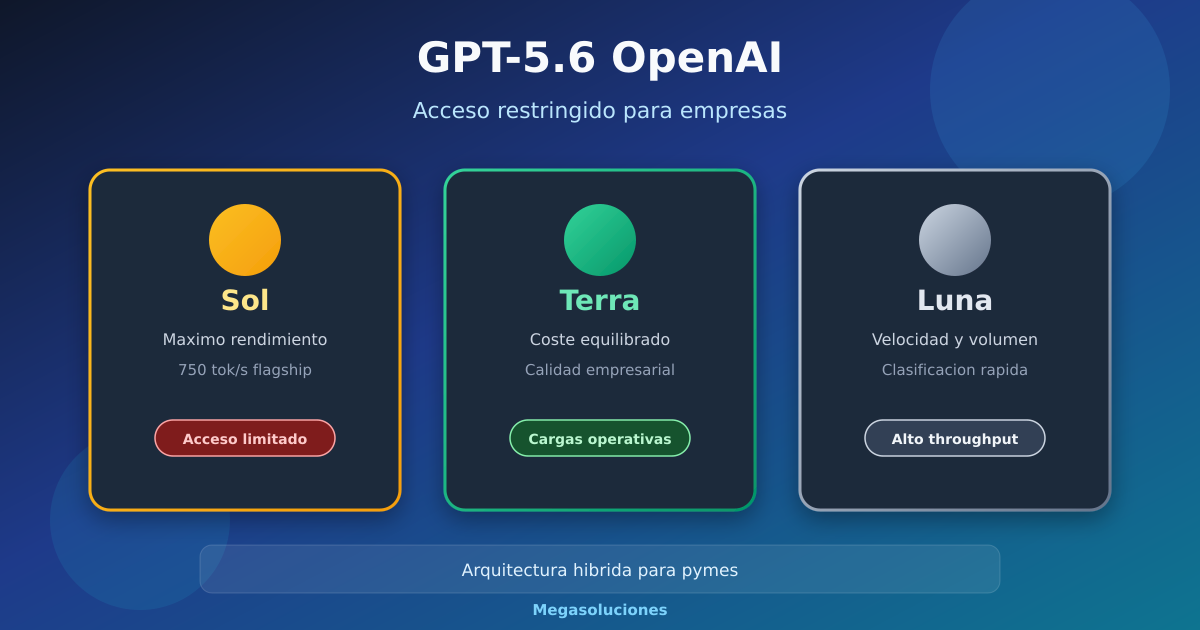
The GPT-5.6 family arrives with three variants aimed at different balances of power, cost, and speed:
Three variants, three usage profiles
Sol
The most powerful variant. According to preliminary benchmarks, it would outperform previous frontier models such as Mitos, with inference pricing similar to GPT-5.5 and estimated speed of up to 750 tokens per second.
Limited accessTerra
Focused on competitive performance with lower operating cost. Designed for business workloads that need quality without always paying for the highest tier.
Operational workloadsLuna
The fastest and most affordable option in the family. Useful for high-volume tasks, classification, or short answers where latency matters more than analytical depth.
High throughputOn paper, the proposition is attractive: more capability without spiking price, with very fast inference. For an SME or mid-sized company already using AI in chatbots, automations, or internal agents, that sounds like "more margin per euro invested." The real question is different: who can use it today, and with what guarantees tomorrow?
Restricted access: more than a technical headline
Despite promising figures, access to GPT-5.6 — especially the Sol variant — is limited. Only a select set of partners can evaluate it, in a scenario where the US government exercises greater control over high-impact AI technologies.
This is not anecdotal for companies in Spain. It is a pattern we have already seen with other frontier models: noisy launch, staggered access, uncertainty about geographic availability, and dependence on decisions outside your business. If your AI roadmap is based on "when model X ships we connect everything," you are outsourcing strategy.
Questions worth asking from management or IT:
- Do our critical processes depend on a single model provider?
- Do we have an abstraction layer to switch models without rewriting integrations?
- What happens if access is delayed, region-limited, or prices rise overnight?
- Are there proven alternatives (open source or multi-provider) for sensitive or high-volume workloads?
In practice, access restrictions may stem from several intertwined factors: training and infrastructure cost, export controls on advanced capabilities, and the need to validate risks before mass deployment. Whatever the cause, the effect on your company is the same: less predictability.
Global competition and a playing field that is no longer OpenAI-only
Meanwhile, Chinese models and open alternatives are closing the performance gap. In the same ecosystem, offerings such as Sakana AI or GLM 5.2 compete with clear advantages in accessibility, local deployment, or cost for certain use cases.
For European companies, this opens two readings:
- Opportunity: more options to avoid being tied to a single North American ecosystem.
- Complexity: more models to evaluate, more questions about compliance, data sovereignty, and long-term support.
The decision is not "OpenAI or nothing." It is designing an architecture where the model is interchangeable and value lies in your data, your processes, and your integration software — not in the hype of the week.
Practical comparison: Sol, Terra, Luna, and the rest of the market
| Model / family | Profile | Current access | Typical business fit |
|---|---|---|---|
| GPT-5.6 Sol | Maximum performance, high speed | Restricted (select partners) | Complex analysis, demanding agents — if and when available |
| GPT-5.6 Terra / Luna | Cost-speed balance | To be confirmed per rollout | Chatbots, classification, drafts, high volume |
| Mitos and previous models | Previous-generation reference | Varies by region | Evolution benchmark; risk of rapid obsolescence |
| Open source (GLM, Sakana, etc.) | Competitive, more controllable | Broad / self-managed | Sensitive data, predictable cost, hybrid deployment |
The lesson is not to pick the benchmark winner of the moment. It is to align each task with the right model and environment: cloud for peaks and cutting-edge capabilities; local or alternative provider for privacy and continuity; deterministic business rules where AI must not improvise.
What Megasoluciones would do if you were our client
We do not recommend pausing AI projects while waiting for GPT-5.6 Sol. We recommend strengthening the foundation to absorb any new model without operational trauma:
- Dependency audit: inventory of where you use AI today (chatbots, RPA, CRM, support, reports) and which provider/model supports each flow.
- Orchestration layer: APIs and agents that allow switching models through configuration, not full rewrites. See how to integrate data into an AI.
- Hybrid architecture: cloud for general tasks; local or private environment for sensitive data. Same approach as in our hybrid AI strategy.
- Pilot with metrics: a scoped case with measurable ROI (hours saved, tickets resolved, errors avoided) before scaling.
- Continuity plan: which alternative model steps in if the primary one becomes unavailable or more expensive.
If your company is in Madrid or elsewhere in Spain, the regulatory framework and public funding also affect timing. It helps to cross model news with AI for SMEs in the Community of Madrid and visibility strategy in SEO and GEO for AI in 2026.
Conclusion: innovate without being hostage to access
GPT-5.6 confirms the model race is still accelerating: more speed, more capability, and prices trying to stay competitive. But restricted access is a reminder of something we often repeat in consulting: the most advanced AI on the market is not a strategy if you cannot use it reliably in your operations.
For SMEs and mid-sized companies, the sensible path is solid integrations, interchangeable models, and projects that prove value in weeks — not waiting for a privileged partner to test the next flagship. At Megasoluciones, we help design that roadmap with AI consulting, custom development, and automations that survive model changes.
AI in business production · AI agents: use cases · Measuring AI project ROI · AI services · Free consultation