How we build less powerful (and more useful) AI models at Megasoluciones
Specializing small models with LoRA and light fine-tunes often outperforms fighting prompts on a generic LLM. Three customization levels for businesses running Odoo and their own data.
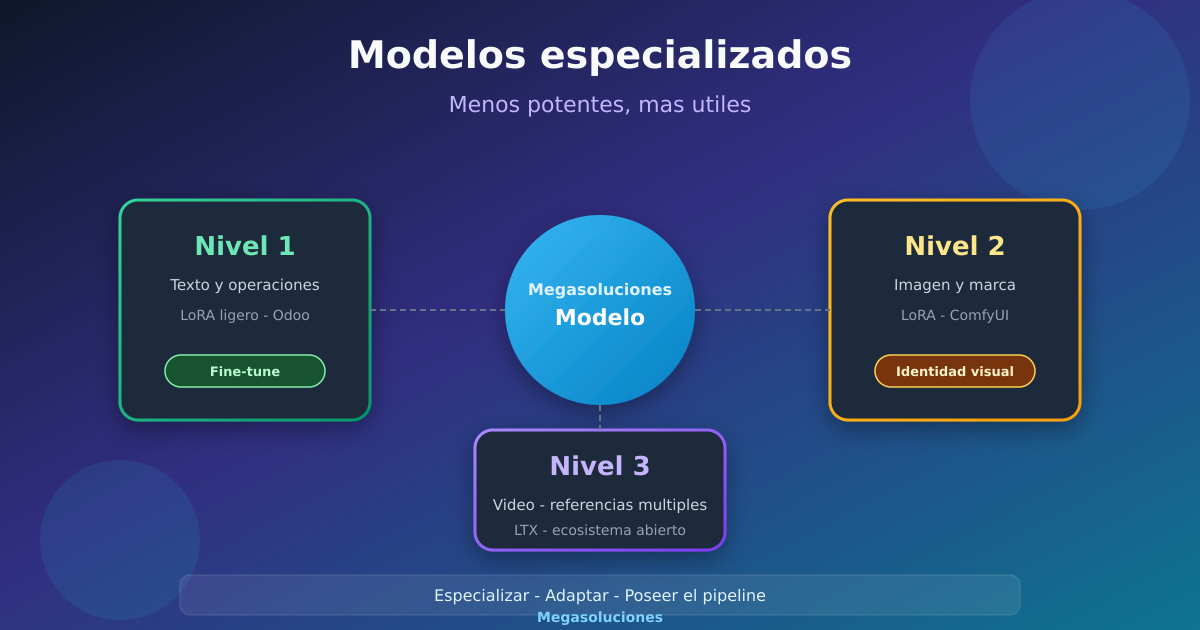
At Megasoluciones we have spent years integrating AI into real processes: Odoo, automation, content, customer support, reports. Every week we become more convinced of one idea that sums up how we work: you can use the world's most powerful model and fight with it until the output resembles what you need, or you can train a small model to adapt to you and deliver the right result every time. This is not about giving up cutting-edge AI. It is about stopping renting generic intelligence when what you need is intelligence that knows your context. More context in our resources on AI for businesses.
The question we ask every week
Companies we work with often arrive with the same pattern: several subscriptions to generic tools, the same prompts repeated over and over, and "correct but empty" results — texts that need rewriting, generic images, reports that do not fit the business.
Our bet is not "more parameters." It is less friction, more precision, more control. Specialize where the task is repeatable; complement frontier models where open reasoning is needed.
Langley and the Wright brothers: the analogy we use in training
In proposals and audits we use an analogy that explains the current AI moment well:
Samuel Langley had US government funding, the best engineers, and unlimited resources. The Wright brothers had a bicycle workshop. Langley built the technically most advanced aircraft… and sank in the Potomac River. The Wrights adapted each part to what they observed worked… and flew.
With artificial intelligence we are at the same point. The winner is not whoever has the biggest engine, but whoever adapts technology to the concrete task with data and business judgment.
Megasoluciones Modelo: when specializing beats scaling
In real projects we start from an open generalist model and adapt it with client data: support tickets, invoices, timesheets, internal documentation, and historical replies from the info@ inbox. The result is what we call Megasoluciones Modelo: a specialized layer on the same base, aimed at the company's operational context — not generic chat tasks.
| Metric (typical pilot in an SME with Odoo) | Generic cloud model | Megasoluciones Modelo (~4–7B parameters) |
|---|---|---|
| Correct support ticket classification | 31% | 87% |
| Acceptable reply drafts without major rewriting | 22% | 74% |
| PDF invoice data extraction vs. GPT-4 (much larger) | — | Megasoluciones Modelo ~91% · GPT-4 ~76% |
The business lesson is direct: a specialized model can outperform a much larger and heavier one on the task that matters to you.
At Megasoluciones we translate it this way:
- Optimize resources: lower inference cost, less latency, ability to run on-premises or on your own infrastructure.
- Optimize precision: invoicing, timesheets, support replies, sector reports — where generic error costs money.
We do not replace frontier models for open reasoning. We complement them with small models that do one thing very well.
Three levels of customization (our working framework)
We structure AI projects in three levels. Each fits differently depending on data, budget, and process criticality.
From light tuning to new skills
Level 1
Community-tuned models or light fine-tunes. Brand tone, fewer clichés, integration with Odoo and mailboxes.
Text and operationsLevel 2
LoRA adapters: visual identity, product, team. Curated datasets of 20–30 well-chosen references.
Image and brandLevel 3
New skills: video with multiple references, outpainting, very specific tasks in the open ecosystem.
Advanced multimediaLevel 1: Use models already tuned by the community
The technique used by major labs is also within reach of teams with judgment. Models published on Hugging Face, tested in LM Studio, or integrated into custom pipelines improve specific traits without training from scratch.
Typical example: tune a language model layer so it writes with fewer clichés and more personality — the model does not lose intelligence, it changes style.
At Megasoluciones:
- We evaluate LoRA and light fine-tunes for brand tone (reports, emails from Odoo, info@ replies).
- We prioritize models the community has already distilled or adapted before proposing costly training.
- We integrate local inference when the client requires data sovereignty (Europe, regulated sector, data on own server). Same line as our hybrid AI strategy.
The model does not lose intelligence, only its style.
Level 2: Train adapters (LoRA) — visual identity and own concepts
Here the difference shows. Open-weight image models — such as Ideogram — can run on your own infrastructure. What matters is not retraining the whole model — expensive, inefficient, and inflexible — but creating a LoRA adapter: a small file that changes the base model's behavior.
Process we replicate in image projects for clients:
- Dataset: ~20–30 reference images (person, product, brand mascot…) from different angles and contexts.
- Tools: Ostris AI Toolkit or other suites to train locally.
- Training: work on the base model, review samples every N steps until convergence.
- Use: load the LoRA in ComfyUI or another flow; generate at the desired resolution.
Before training, the model does not "know" your reference; after LoRA, it identifies it with high fidelity. What changed: a file of a few megabytes generated in minutes.
Principle we apply at Megasoluciones:
Garbage in, garbage out. With 20 bad or identical photos, the result will be poor. With good references it works surprisingly well.
Operational advantages:
- As many LoRAs as you need: one per client, one per style, one per campaign.
- The file is small and swaps in one click; you can even combine them.
- For brands working with us on web, Odoo catalog, or commercial material: coherent assets without relying on a generic prompt every session.
Level 3: New skills — video, multiple references, and specific tasks
The most powerful level is not teaching the model what something looks like, but how to work differently.
Example from the open ecosystem: LTX 2.3 with an "ingredients reference sheet" LoRA. A prompt or first frame is no longer enough: you upload an image with references (character, objects, setting) and the model generates video while keeping fidelity to all elements.
Summary flow:
- Local environment (e.g. Pinokio + ComfyUI).
- Distilled LTX 2.3 model; quantized versions if GPU is limited.
- Multiple-reference LoRA enabled.
- Configure ingredients reference sheet and upload the character sheet.
- Two-part prompt: what is in the reference image + what should happen in the video.
The LTX 2.3 ecosystem already includes LoRAs for water simulation, outpainting, day → night, colorization, shot refocus, and dozens more cases. The more concrete and specific the task, the better the results.
At Megasoluciones this fits training tutorials, product prototypes, and automation of repetitive visual pieces — not replacing human creativity, accelerating iteration.
In pure quality, cloud APIs such as Seedance or Google Veo may be ahead today in some scenarios. But the key concept is different: an open-weight model can be customized toward the specific direction and task you need. And you can own the pipeline, not just the prompt.
From renting AI to owning specialized AI
We use this question as a maturity test in AI audits:
What you generate with your AI subscriptions — could you easily tell it apart from what any other user gets?
The difference is no longer having access to ChatGPT, Claude, or Gemini. Everyone has that.
The difference is AI that:
- Understands your context (Odoo, your processes, your tone, your products).
- Adapts to how you work.
- Solves the tasks that matter to you better.
At Megasoluciones we do not sell "another chat." We develop and integrate:
- Light models and adapters where the task is repeatable and measurable.
- Local or European pipelines when data cannot leave the client's perimeter.
- Business layer (Odoo, automations, inboxes, reports) so AI does not stay an isolated experiment.
Owning generic artificial intelligence is only half the journey. Owning artificial intelligence that knows your specialty, your style, and solves the tasks you care about better — that completely changes how useful this technology is.
And you no longer need a lab to start. You need judgment, quality data, and a partner who can take it to production.
What we do concretely at Megasoluciones
Text and operations (Level 1)
- Light fine-tunes and LoRA for email replies, reports, and documentation with brand voice.
- Agents connected to Odoo (invoices, timesheets, CRM, info@ inbox).
- Small models on own server or European VPS when token cost or privacy demands it.
Image (Level 2)
- Product, team, or visual identity LoRA for catalogs, web, and campaigns.
- Curated datasets: 20–30 well-chosen references, not 200 random photos.
- ComfyUI flows and open tools reproducible by the client.
Video and multimedia (Level 3)
- Proof of concept with LTX + reference LoRA for training and technical marketing.
- Continuous evaluation vs. cloud APIs: quality vs. cost vs. control.
- Roadmap aligned with the open ecosystem (new LoRAs, quantization, modest GPUs).
Conclusion: less powerful, more precise
Building "less powerful models" at Megasoluciones is not swimming against the tide. It is applying the same logic that worked in aviation, in our Megasoluciones Modelo pilots, and in thousands of open-source projects:
- Specialize instead of genericize.
- Adapt instead of fighting the prompt.
- Own the adapter, the dataset, and the flow — not just the monthly subscription.
We bring it to companies that invoice, serve customers, and operate with Odoo: less hype, more results.
If you want to explore how to apply these three levels in your organization — starting with a concrete task, not "adopting AI" in the abstract — we can audit the case, propose the right level, and integrate it into your systems.
AI in enterprise production · Integrating data into AI · Hybrid AI strategy · AI agents: use cases · AI services · Free consultation