First phase of consulting: BPMN audit roadmap, opportunities, and technical roadmap
Complete methodology of the first phase of consulting: BPMN workshop with deliverable diagram, opportunity matrix, vulnerability report, and phased technical roadmap.
The first phase of consulting with Megasoluciones is a four-phase diagnosis with real deliverables — not a sales call. We start by drawing the process in BPMN, followed by an opportunity matrix, a vulnerability study, and a phased technical roadmap. Below is the detail of what we do in each step.
1. Process Audit (BPMN Drawing)
What it is and why we do it
Before talking about software, RPA, or AI, we need to see how you really work. Not the organizational chart or an ideal PowerPoint: the flow that a person follows when an order comes in, an invoice arrives, or a ticket is closed.
We use the BPMN 2.0 notation (Business Process Model and Notation) because it is an international standard: management, operations, and development read the same diagram without misunderstandings.
How we work (methodology)
- Kick-off (30–45 min): we agree on scope (a process or a department), interlocutors, and access to example systems.
- Interviews and shadowing: we talk to those who execute the process and, if possible, observe a real day (in-person or remote).
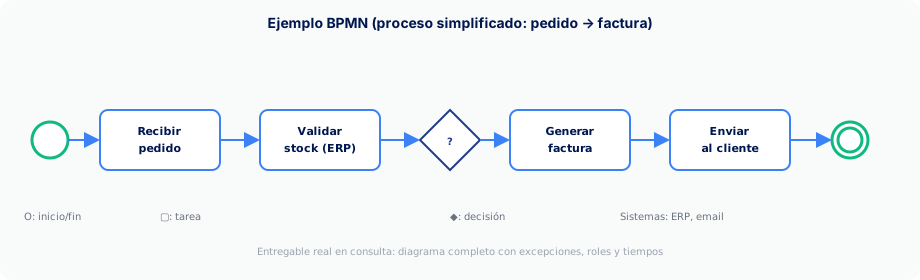
- BPMN Drafting: we model start/end events, tasks, decisions (gateways), actors (pools/lanes), and involved systems (ERP, CRM, Excel, email…).
- Validation with you: we review the diagram with you before moving on to the opportunity analysis. We correct exceptions that only those who live it day by day know.
What the BPMN diagram includes
- Events (circles): start, end, and relevant interruption points.
- Tasks (rectangles): manual or automatic steps, with responsible parties.
- Gateways (diamonds): decisions (“stock OK?”, “requires approval?”).
- Flows (arrows): real order, including exception routes.
- Actors and systems: who does what and in which tool (Odoo, Salesforce, spreadsheet…).
- Indicative times per stage when you know them (hours/day, days/week).
Deliverables of this phase
- BPMN 2.0 diagram in PDF and editable format (BPMN XML or modeler source).
- Inventory of actors, systems, and handoffs (where time is lost or work is duplicated).
- List of bottlenecks and repetitive tasks (candidates for automation).
Related reading: why processes need to be organized before automating · which processes to map in an SME.
2. Opportunity Analysis
What we do
With the validated BPMN, we evaluate each possible improvement on three axes:
- Impact: hours saved, errors avoided, income protected or accelerated.
- Effort: technical complexity, necessary integrations, organizational change.
- Risk: sensitive data, supplier dependency, business continuity.
Prioritization Matrix
We build a matrix where each opportunity receives a score and a clear recommendation:
- Automation (RPA or APIs): when there are clear rules and repetitive systems — see RPA vs APIs.
- Custom development: when there is no product that fits your flow.
- Applied AI: when there is a volume of documents, queries, or classification with learnable rules.
- Discard or postpone: when the ROI does not close or the process is not yet stable.
Deliverables of this phase
- Impact / Effort / Risk matrix with initiative ranking.
- Indicative ROI estimation (hours × hourly cost vs investment).
- Recommendation of approach: specific pilot and what not to touch yet.
More context: processes that usually give the most ROI · automation service.
3. Vulnerability Study
What we review
Before budgeting development or deploying a bot, we identify what can fail or expose the company:
- Data: categories (personal, financial, contractual), where they reside, who accesses them, retention.
- Integrations: available APIs, credentials, limits, single critical supplier.
- Operation: what happens if a workflow, a server, or an external AI model fails.
- Compliance: GDPR, logs, backups, traceability of automated decisions.
- Security: access, environments (dev/prod), anonymized test data.
Deliverables of this phase
- Brief report of risks classified (high / medium / low).
- Map of integrations and dependencies between systems.
- List of mitigation measures prioritized before the pilot.
References: integrate data in AI · hybrid cloud/local strategy · privacy and GDPR.
4. Technical Roadmap
Phase Structure
We close with an executable plan, not a generic document:
- Phase 0 — Pilot (3–6 weeks): a limited process or module, defined success metrics, test environment.
- Phase 1 — Integration and Deployment: connection with existing systems, training, monitoring, and alerts.
- Phase 2 — Scale: extension to other departments, evolutions, and continuous support.
What the roadmap includes
- Indicative schedule per phase and dependencies (access, test data, internal interlocutor).
- Criteria for transition between phases (what must be met to scale).
- Agreed KPIs (hours saved, errors, cycle times).
- Economic proposal per phase, if applicable, without commitment until you validate the scope.
Deliverables of this phase
- Roadmap document (PDF) with phases 0, 1, and 2.
- Table of internal and external responsible parties.
- Detailed indicative budget (when the scope allows).
Examples: development cost by phases · ERP-CRM pilot case · how to choose a provider.
Summary: what you get from the first phase of consulting
BPMN
Diagram of the real process, validated with you, with actors and systems.
Matrix
Prioritized opportunities with impact, effort, risk, and indicative ROI.
Risks
Report of technical, data, and integration vulnerabilities.
Roadmap
Phase plan with timelines, KPIs, and economic proposal if applicable.
Duration and format
- Usual duration: 1–2 weeks from kick-off to roadmap delivery (depending on process complexity).
- Format: remote or in-person in Spain; 60–90 min workshops per phase.
- Commitment: no obligation to hire; the deliverables are yours even if you do not continue with the project.
Book first phase of consulting · Automations · Custom Development