AI agent for HR: Delaviuda case and how we would integrate it at Megasoluciones
Editorial analysis of the Delaviuda case (Softeng): 24×7 agent, document RAG, and payroll tutoring. Not a Megasoluciones project; how we would deploy it with Odoo and consulting.
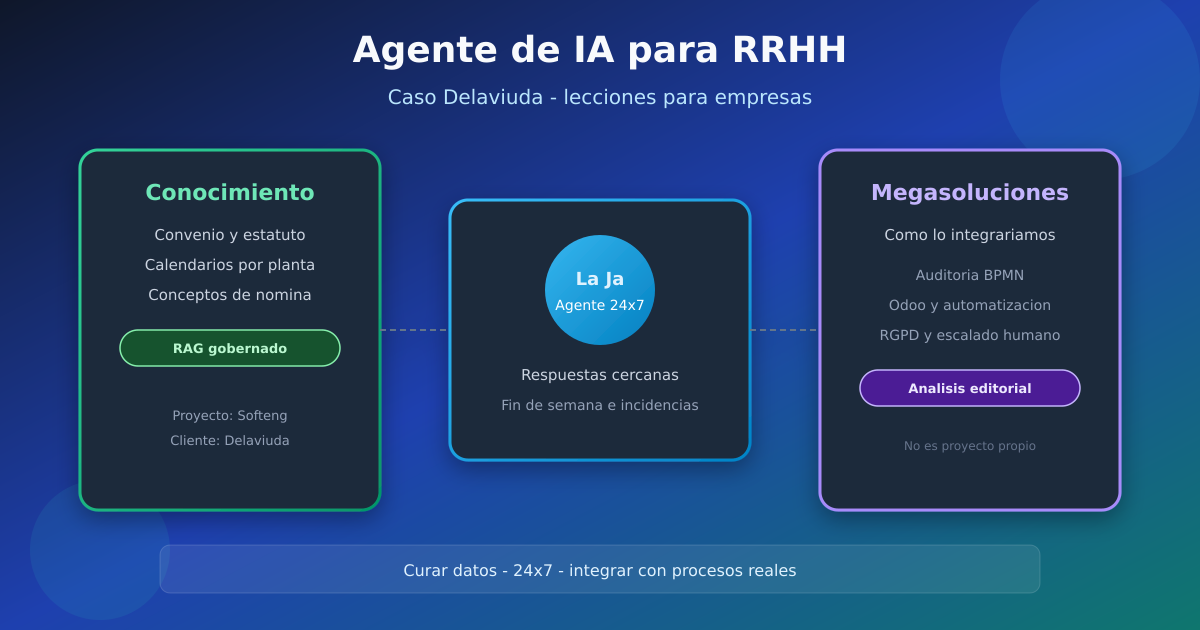
Carlos Durán, CIO of Delaviuda, sums up in a few minutes what many companies take months to learn: an AI agent in Human Resources only works if it knows which documents it may read and what it must not touch. Collective agreement, workers' statute, site calendars, payroll concepts explained without opening personal data — available when an employee asks on a Sunday. Megasoluciones did not take part in this project; we analyze it because it matches deployments we do for SMEs with Odoo, automation, and agents with real context. More context in our resources on AI for businesses.
Context: Delaviuda Group and the HR challenge
Delaviuda is a Spanish food-sector group known for brands such as La Viuda and El Almendro. According to its CIO in Softeng's video, the challenge was to gain efficiency across business units through artificial intelligence — starting with an area with high volume of repetitive queries: Human Resources.
Employees kept asking about collective agreements, calendars, sick-leave deadlines, or payroll line items. The HR team absorbed time that could go to complex cases. The bet: an AI agent with the right structure to access internal and external documentation, simple communication, and 24×7 availability.
What they built (according to the case published by Softeng)
The project was not "install a chat." It was designing which knowledge to expose and how to deliver it. Delaviuda and Softeng distinguished two data layers:
External documentation
- Applicable collective agreement
- Workers' Statute
- Reference labor regulations
Internal documentation
- Work calendars by location and site
- Special agreements per plant
- Company policies and procedures
A key design addition — identified during the process with Softeng — was payroll concept tutoring: answering questions like "what does complement mean on my payslip?" by explaining the concept in general, without initially accessing each person's individual payslip. That reduces risk and deflects mass queries without opening unnecessary sensitive data.
The assistant, with a friendly tone, is presented in the video as "La Ja". Delaviuda chose the Microsoft ecosystem, aligned with the group's existing trust and stack.
Why it is a success story (beyond the hype)
What makes this deployment interesting is not the model brand, but operational fit:
- Real moment of doubt: an employee asks on Saturday or Sunday — after a family incident or accident — how many days they are entitled to. HR is offline; the agent is not.
- Curation before chat: the project focused on defining which documents were published to the service, not launching an empty bot.
- Layer separation: public regulations + internal policies + concept explanation, without mixing everything in a generic prompt.
- Employee experience: friendly language and continuous access, not a cold form.
Carlos Durán describes Softeng as the project's "lighthouse" in an environment where AI rules change every week — a metaphor we recognize: without business and technical guidance, many companies sail blind.
What the video does not detail (and should be planned)
For management or IT analysis, pieces Megasoluciones would require before scaling are missing:
- Metrics: % of queries resolved without human escalation, average response time, employee satisfaction.
- GDPR and audit: conversation retention, legal basis, access and erasure rights.
- Human escalation: when the agent must say "I don't know" and open an HR ticket.
- Payroll and ERP integration: where it may automate vs. only inform.
- Document updates: who versions agreements and calendars when they change.
No HR agent should go to production without these answers — regardless of vendor or cloud.
How we would integrate it at Megasoluciones
If a client asked for a similar scenario, we would not copy stack or vendor: we would replicate the business logic with our methodology. The starting point would be the first phase of consulting (BPMN audit, opportunity matrix, risks, and roadmap).
| Megasoluciones phase | Applied to an HR agent |
|---|---|
| 1. BPMN audit | Map real flow: employee asks → intranet, email, phone, or HR |
| 2. Opportunity matrix | Which queries are document RAG, which tickets, which sensitive data is forbidden |
| 3. Risks and compliance | GDPR, individual payroll, OHS, leave; "I won't answer" policy |
| 4. Technical roadmap | Pilot at one site → legal/HR validation → multi-site rollout |
Stack we would propose (without imposing Microsoft)
Delaviuda chose Microsoft with Softeng. At Megasoluciones the stack depends on the client:
- RAG on versioned documents (SharePoint, Drive, European VPS repository, or intranet).
- Agent with tools: search policy, check calendar, open ticket, escalate to a person.
- Hybrid layer: natural language in the cloud where it fits; deterministic rules for deadlines and days where AI must not improvise. Same line as our hybrid AI strategy.
- Odoo if already in production: leave, timesheets, info@ inbox, FAQ synced with the agent.
- Specialized models where the task is repeatable — see Megasoluciones Modelo.
Checklist before a similar pilot
- Closed, signed list of documents the agent may cite.
- Explicit policy: no answers with personal payroll data unless authorized integration exists.
- Escalation flow to human HR with SLA different from 24×7 if the team is not available.
- Legal review of agreement, OHS, and leave procedures.
- Agreed KPI: queries resolved without intervention, not just "we have a chatbot."
Delaviuda vs. a Megasoluciones project: same logic, different ship
The video metaphor fits: Softeng was the lighthouse; Microsoft, the ship Delaviuda already knew. For another company the ship may be Odoo + automations + agent on European infrastructure. What does not change: curate data, bound risks, measure, and connect the agent to the real process — not leave it as an isolated experiment.
At Megasoluciones we do not sell licenses for a specific ecosystem. We integrate AI agents where ROI is measurable: fewer repetitive tickets, less HR time on FAQ, better employee experience.
Conclusion
The Delaviuda case — documented by Softeng — shows that a useful HR agent is born from a governed knowledge catalog, not the trendy model. 24×7 availability and "La Ja" closeness are the visible layer; underneath are months of decisions on what to expose and what to protect.
If your organization has the same pattern — repetitive queries, several sites, different agreements, payroll doubts on weekends — we can audit the case, propose a bounded pilot, and integrate it with your systems. Without copying Delaviuda: learning from what already works in the market.
Editorial analysis by Megasoluciones based on the interview with Carlos Durán (CIO, Delaviuda) published by Softeng. Original project: Softeng / Delaviuda Group. Source video: YouTube.
AI agents: use cases · First phase of consulting · Integrating data into AI · AI services · Free consultation