Tourist itineraries with AI: from spreadsheet to a web ready for public demo
How to turn a catalog of points of interest into a platform that generates personalized routes, manages multiple cities from an admin panel, and is exposed on the internet in one step — without rewriting data or losing traceability.
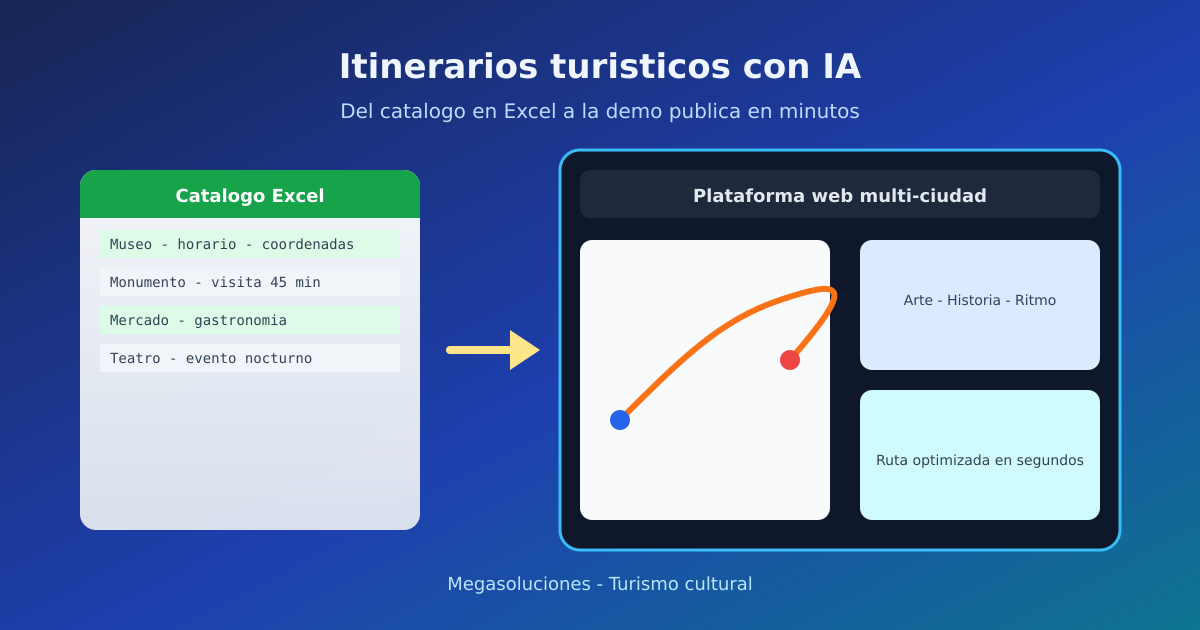
Many tourism projects start with Excel: museums, monuments, schedules, coordinates. The challenge is not only to digitize that information but to make it useful for the visitor and operable for the team that maintains it. We have built a web application that imports catalogs by city, applies user preferences, and generates itineraries with artificial intelligence, maintaining human control over data, users, and deployment.
Data as the source of truth
Points of interest live in a central database: schedules, categories, coordinates, accessibility, and editorial notes. They can be imported from spreadsheets and updated from the admin panel. This way, the destination does not depend on a developer to change a summer schedule or add a one-time event.
For tourism offices and heritage managers, this means a single source of truth shared between the public web, internal team, and future integrations (QR in monuments, newsletters, etc.).
Real personalization for the visitor
Listing places is not enough. The visitor indicates how much time they have, what interests them, and how they prefer to move around. The system combines editorial criteria (what fits with what) with route optimization (distance, walking time, logical order of stops).
- Interests: art, history, gastronomy, nature, local shopping…
- Pace: relaxed or intense visit; family or couple; morning or afternoon.
- Result: mobile-readable itinerary, not a random list of POIs.
AI with clear limits
Language models help summarize, suggest combinations, and draft accessible texts. But business rules — what is open, what requires a reservation, what should not be mixed — remain in the backend and in the hands of the destination team. AI accelerates; it does not replace the judgment of those who know the city.
Frictionless operation for the team
A digital tourism project only works if the team can operate it after launch:
- Centralized logs to see what happens when something fails.
- Integrated verification and password recovery emails.
- Operational configuration editable from the panel (no emergency deployments for a minor change).
- User and city management from the same interface.
Public demo in minutes
Before investing in marketing or institutional agreements, it is necessary to validate with real visitors. The platform allows publishing a demo on the internet with secure access, showing a URL ready to share with the press, partners, or focus groups — without setting up complex infrastructure for each test.
Who this approach fits
Cultural destinations, heritage routes, councils with multiple municipalities, foundations managing heritage, or smart tourism projects that need to iterate quickly: load a new city, test with visitors, adjust catalog and rules, and measure again.
See the full case in portfolio · Custom development · Request a similar project